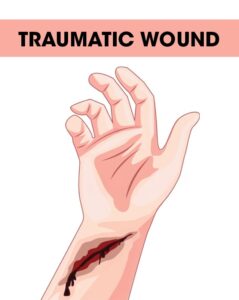
Your Simple Guide To Lacerations
- admin-fibroheal
- February 24, 2026
What Are Lacerations?
Talking about, lacerations, they are traumatic injuries that involve rips or tears in body’s tissues. While skin lacerations are the most predominant, these wounds can happen to tissues inside individual’s body, too. They can even happen without the laceration impacting the outside of body.
Lacerations are incredibly predominant. They can be as minor as a day to day paper cut or nick while shaving or as severe as fatal wounds that require emergency medical care.
Symptoms of lacerations
The primary symptoms of a laceration are pain as well as bleeding. If the laceration impacts or passes through skin, it will cause a visible opening in skin’s surface. But if the laceration is internal only, such as a torn muscle, one may have distinct symptoms, like bruising or swelling.
The type or site/location of tissue impacted can alter or aggregate the symptoms that you experience. For example, face or scalp will usually bleed extremely heavily because they’re packed full of capillaries. And lacerations to blood vessels, for instance, veins as well as arteries, also bleed heavily.
And few manifestations are very specific to certain forms of lacerations. For instance, a nerve laceration can cause tingling, numbness, weakness or paralysis, (or nerve pain).
Causes of lacerations
Lacerations can occur when something causes ripping or tearing of tissues in body. Few of the most predominant causes comprises, but aren’t restricted to, the following:
- Utilizing knives or other sharp items/entities.
- Working with edged tools or objects/entities
- Sports-related injuries
- Bites from animals or humans
- Falls or other types of blunt impacts
- Vehicle collisions
- Physical assault
- Skin tears related to bedsores (pressure injuries)
- Penetrating injuries that tear or rip tissues inside body
- Rings or jewellery that snag or pull, tearing through skin or taking sites of skin with them.
Lacerations usually involve one or more of the following: - Sharp edges: This damages the skin’s outer layers, making it tear more easily.
- Blunt force: This can put excess pressure on the impacted tissue, making it split, tear or burst. Blunt force injuries can cause lacerations inside body without breaking skin.
- Shearing: This is when tissue experiences movement forces in more than one direction, or when tissues next to each other pull apart. Shearing injuries can also cause internal lacerations without breaking skin.
Several lacerations comprise more than one of the above, especially when the laceration is more severe. For instance, lacerations can be too large when a tear occurs with a lot of force, making the wound bigger. One specific example of this would be ring avulsions.
So, if individual has a laceration that might comprise multiple forms of damage or injury, superb bet is to seek professional medical care. Erring on the side of caution can make a big distinction in the long run.
Complications of lacerations
Few of the most predominant complications of lacerations comprise:
Infections: The probability of these goes up when wounds are larger and/or deeper. Infections are also more likely to occur with bites and when it takes longer to get treatment. And wound site/location matters, because infections are more likely with lacerations on limbs.
Scarring: This is also more likely with larger, deeper or slow-to-heal lacerations.
Tissue-specific effects: Few complications are specific to the form of tissue injured. For instance, permanent numbness or weakness is a possible complication of nerve lacerations.
The complications individual might experience can be very specific to person’s case, health history as well as other factors. Their healthcare provider is the best person to tell about the possible complications.