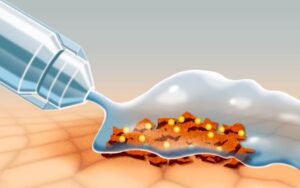
Initially, it can be tough to judge the severity of a burn. However, healthcare/medical professionals assess the severity based on the degree of depth of the damage. Rephrasing words, how deep does the burn go? This is why certain times we hear burns called as partial and full thickness, but what does that mean?
Burn Depth Meaning
When healthcare professionals discuss about burn thickness or severity, they are referring to how deeply the injury has penetrated through the skin layers. Although we usually think of skin as a single layer, it is actually comprised of multiple distinct sections:
Epidermis – Refers to the outermost layer, predominantly identified as the visible skin surface.
Papillary Dermis – Refers to a layer beneath the epidermis comprising connective tissue and blood vessels.
Reticular Dermis – Refers to the deeper, thicker portion of the dermis that offers strength and structure.
Subcutaneous Fat – Refers to the innermost layer composed of fat, located beneath the skin.
Burn depth is divided based on how many of these layers are impacted. The more severe the burn, the deeper it extends into the underlying tissues.
Thickness vs. Degree
We may listen burns referred to as degrees. This is just an alternative way of classifying burns. The degree depicts the thickness of the burn. For instance: 1st degree = superficial thickness 2nd degree = partial thickness 3rd degree = full thickness
A 3rd-degree burn refers to a full-thickness burn as well as depicts a serious injury.
Overview Of Partial Thickness Burns
Partial-thickness burns are further categorized into superficial, mid, as well as deep levels, based on how far the damage extends into the skin.
Superficial partial-thickness burns impact the epidermis and extend into the upper papillary dermis.
Mid partial-thickness burns involve the epidermis and reach the middle portion of the papillary dermis.
Deep partial-thickness burns extend through the epidermis, papillary dermis, and into the reticular dermis.
Any burn that penetrates beyond the epidermis but does not reach the underlying fat layer is regarded a partial-thickness burn.
Appearance of Partial-Thickness Burns
The visual characteristics differ with severity. These burns may appear pale pink to bright cherry red. Blistering is predominant in superficial and mid partial-thickness burns, where fluid collects beneath the skin to form a protective barrier against infection. In contrast, deep partial-thickness burns typically do not form blisters.