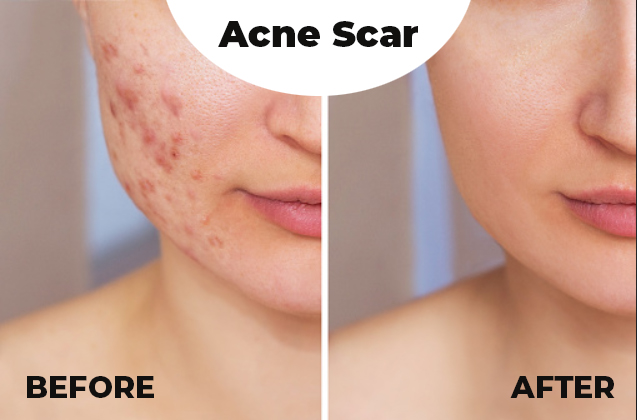
Acne scars on the face, chest as well as back are very predominant. Some 80% of individuals between ages 11 and 30 will get acne, and one out of five of those individuals will develop scars.
How does acne cause scars?
As we know, skin is person’s largest organ. It has three major layers. They are, starting with the outermost, the epidermis, the dermis and the hypodermis. The layers shield fragile insides from the elements, from UV rays and germs/bacteria, and they also help synthesize vitamin D thanks to sunlight. Any area/site/portion with sebaceous glands is prone to acne — especially the face, back as well as chest.
Acne scars are the result of inflammation of acne blemishes. The acne pore swells and a breakdown occurs in the wall of the pore. Some acne blemishes are small and the scars created are shallow and heal quickly. Sometimes the contents of blemishes spill into the surrounding tissue and cause deeper scars. The skin’s response is to repair the scar by forming new collagen fibers.
Acne scars take on two main forms: either a scar develops when there is a loss of tissue, resulting in an indentation in the surface of the skin; or, a scar develops that is raised on the surface of the skin. This type of acne scar, in fact, is a sign that skin is doing its task — but, perhaps, too well. Individual’s skin produces collagen (“repair tissue”) to help heal the wound — the acne — but, if it makes excess collagen, raised scars form.
What are the types of acne scars and what do they look like?
If you have acne scarring, you’re likely to have more than one of the following types. Rarely does someone have just boxcar scars, or just keloid scars, etc. Each of these can be treated with varying degrees of success.
Atrophic or Depressed Scarring:
Ice pick: An ice pick tool has a wide shaft that narrows down to the tip. This type of acne scar resembles the tool in that it’s a hole that’s wide at the top and narrows to a point as it goes deeper into the skin. Such an indentation is common and also one of the most challenging scars to heal. You’ll find them on your forehead and upper cheeks, where your skin is thinner.
Rolling: These scars are typically found on the lower cheeks and jaw, where your skin is thicker. The indents have sloping edges that makes the skin look uneven and wavy.
Boxcar: Boxcar scars are indents that have sharper edges. Those edges go down deep into the skin. These scars are common on the lower checks and jaw.
Hypertrophic or keloid scars:
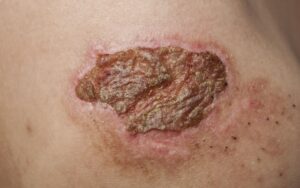
These lesions of scar tissue rise off the skin. They’re caused when fibrous tissues, the collagen, in the region of the skin overgrow. These scars are usually found on the chest, back and shoulders and jaw line and can be itchy, tender or painful.
Fibroscar Gel
Intense bioactive formula for skin moisturization and scars formed due to acne