
Burns: Causes, Types, And Degrees
- admin-fibroheal
- December 18, 2025
Do you know? Burns are extremely predominant and in the majority of scenarios unintentional. Worldwide, about 10 million individuals experience burns, and about 180,000 die from them each annually.
What are burns?
In simple terms, burns refers – a type of injury that happens when something — usually something hot — damages tissues of individual’s body. They’re more severe when they’re deeper and cover a larger portion of an individual’s body’s surface area.
Types of burns
- Thermal burns (hot/cold): These involve cellular damage from high end temperatures.
- Electrical burns: These happen when electrical energy overloads a person’s cells. Electricity also produces heat as well as causes thermal damage.
- Friction burns: These burns happen when something rubs against your body hard enough to generate heat. The amount of force required for these burns typically causes other types of damage, too.
- Radiation burns: This happens when distinct forms of radiation damage a person’s cells, which then break down and die.
- Chemical burns: These happen when chemicals, usually ones that are acidic (acids) or alkaline (bases), try to react with a person’s cells and destroy them.
What causes burns?
Burns can happen in several ways, comprising:
- Touching something extremely hot or cold, such as – hot stove/dry ice.
- Contact with very hot air (like air from an open flame or an electric hair dryer) or very cold air (like severe wind chill that causes frostbite on exposed skin).
- Contact with very hot liquids (like boiling water/hot cup water) or very cold liquids (like liquid nitrogen).
- Conducting electrical current through your body from things like downed power lines, damaged power cables/cords, lightning and automobile batteries.
- Falling on paved surfaces, which can cause road rash.
- Moving against rougher fabrics — like in clothing, upholstery, carpets — with a lot of force and/or for an extended time.
- Staying in the sun for a long duration without adequate protection.
- Receiving medical treatments such as radiation therapy.
- Contact with chemicals such as those found in cleaning products as well as construction supplies.
Degrees of Burns
Experts assess on the basis of how severe a burn is partly by how deep it goes. The older system of rating burns by degrees is no longer in widespread use. Instead, experts utilise the following system:
- Superficial (similar to first-degree). These only damage the epidermis, which is top layer of skin. These are minor and always self-treatable.
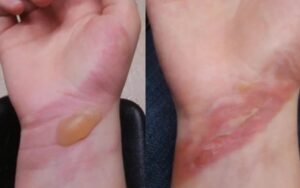
- Partial-thickness (similar to second-degree). These go deeper, damaging the outer two layers of your skin. They can blister, cause color or texture changes more than just simple redness and be painful.
- Full-thickness (similar to third-degree). These burns go through all skin layers and can reach all the way to the fatty tissue underneath the dermis. Full-thickness burns destroy nerve endings, so they don’t hurt.
Burns can extend even deeper and damage muscles, nerves, bones and other deep tissues. These aren’t as predominant, and experts sometimes call these fourth-degree burns.
How are burns diagnosed?
- A healthcare provider can diagnose burns by examining the injury and by asking questions/queries about what happened.
- Lab and imaging tests don’t usually help diagnose burns but can help catch complications prior to them becoming severe.
- Blood and urine tests are especially important for finding signs of organ damage or infections.
- CT scans and magnetic resonance imaging may help detect deeper tissue damage in a few cases, but these aren’t usually necessary.
In case of minor wounds – FIBROVID (a broad-spectrum topical antiseptic and wound healing ointment), which has a unique patented combination of Povidone-Iodine (PVP-I), a complex polymer of polyvinyl pyrrolidone with iodine and silk protein could act as boon.